On October 1, 2026, Google updated the page that tells site owners how to handle AI-generated content. The old version said to focus on accuracy and quality. The new version says why that matters, in language direct enough that it reads like a warning rather than a suggestion.
What Google added
The new language explains the mechanism as well as the outcome:
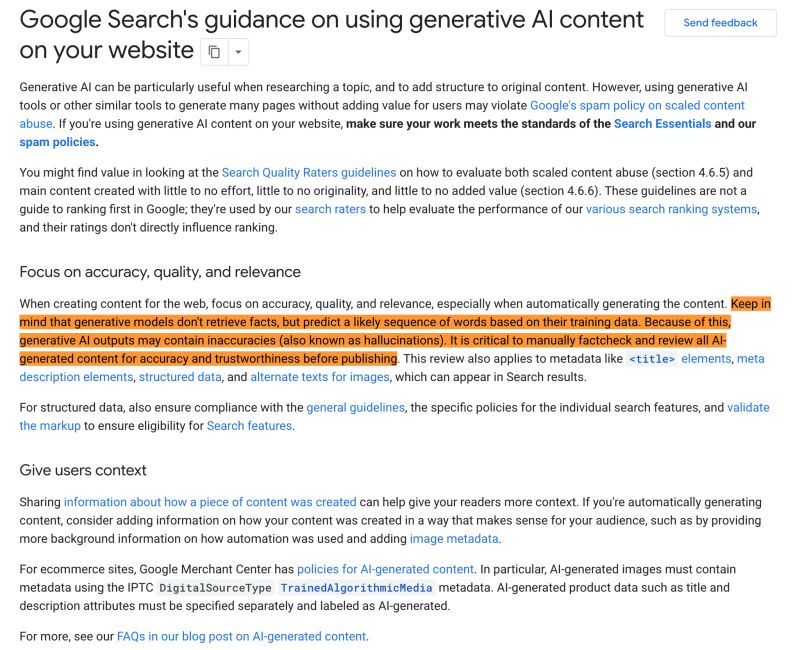
"Keep in mind that generative models don't retrieve facts, but predict a likely sequence of words based on their training data. Because of this, generative AI outputs may contain inaccuracies (also known as hallucinations). It is critical to manually factcheck and review all AI-generated content for accuracy and trustworthiness before publishing."
It isn't a new policy. The page already asked for accuracy, quality and relevance. What changed on October 1 is that the guidance now explains why AI output goes wrong, in plain terms, and attaches the word "critical" to manual review before publishing.
The part most people will miss: the review covers your metadata
The update reaches past article bodies. The page already said its guidance included metadata, and it now states that "this review also applies to metadata", naming title elements, meta descriptions, structured data and image alt text. That covers anything AI might have generated or touched on its way into your CMS.
That matters more than it sounds like it should. A lot of AI-assisted workflows generate the article carefully and then let a tool auto-fill the meta description or the schema markup with far less scrutiny, on the assumption that metadata is low-stakes. Google's update treats it as the same risk category as body content: if a model wrote it, a human needs to check it before it goes live. If you've never audited whether your structured data matches what's on the page, does schema markup help SEO is worth reading alongside this, since the honest answer to what schema does for you also explains why Google cares if it's wrong.
Work With John
If your site isn't bringing in enquiries, that's fixable.
I work with US service businesses and B2B brands on SEO, websites and lead follow-up. On a free strategy call, I'll tell you what's holding your site back, without a sales pitch.
Book a free strategy callWhy this is a spam policy question as well as a quality one
Google ties this directly back to its policy on scaled content abuse, publishing many pages with little original value, little effort, and little human oversight. The guidance points to the Search Quality Rater Guidelines sections that cover exactly this: content created with little to no effort, little to no originality, and little to no added value.
Google has said repeatedly that it doesn't penalize content simply for being AI-generated, and nothing in the update changes that. The real risk is narrower and more specific: AI content published without review is statistically more likely to contain the kind of low-effort, unoriginal, low-value signal that the existing spam policy was already built to catch. The update doesn't introduce a new penalty. It names the mechanism by which AI-assisted publishing walks into an old one.
What "manually fact-check" means in practice
Vague instructions get followed vaguely, so here's what the review looks like as a process.
Every specific claim gets checked against a real source, not against whether it sounds plausible. The test is whether you can point to where a number, date or statistic came from, rather than whether it reads correctly. Statistics are the highest-risk category here: a model will produce a convincing percentage or dollar figure with complete confidence whether or not that figure exists anywhere in reality, because confidence was never the thing it was optimizing for. Treat every number a model hands you as unverified until you've checked it, the same way you'd treat a number a stranger told you with total certainty and no citation.
The metadata gets the same scrutiny as the body, not a lighter pass. Title tags, meta descriptions, and schema fields that got generated in the same batch as the article are exactly as likely to contain an invented detail as the article itself, and they're often reviewed less carefully because they feel like formatting rather than content. Alt text falls into the same trap: it needs to describe what's in the image, not a generic guess at what an image in that position usually contains.
It's also worth asking what a chat tool can't verify before trusting anything it hands back. A model answering questions about your own site has no way to check its answers against your site. I wrote about exactly this limitation in can ChatGPT audit your website's SEO: a tool that can't retrieve facts can't confirm the facts it generated either, whether it's auditing your site or writing a paragraph about it.
A real example of what this catches
Here's the failure in concrete terms. An AI-assisted draft states a specific number with total confidence, a traffic figure, a client result, a date something happened. It reads fine. Nothing about the sentence signals that it's wrong. The only way to catch it is to check the number against the record it claims to describe. When I reviewed older content on this site, I found figures that didn't match any real record, and they came out.
That's the whole problem in one sentence: fluent and wrong look identical until someone with the real source checks. Google is describing something that happens constantly to anyone publishing AI-assisted content without a verification step. A better prompt won't fix it. A person with access to the real numbers checking them will.
Does this mean you should stop using AI for content?
No, and Google's guidance has never said so. The update targets unverified AI content, which is a narrower and more useful target than AI itself.
AI is useful for structure, for a faster first draft, for research that would otherwise take hours. What it can't do is know whether the specific facts it generated are true, because that was never part of what it's doing. It's predicting a plausible next word, not checking a database. Treating those as the same thing is the mistake this guidance corrects.
How I run this on my own content
I use AI in my own writing and research, openly. The model drafts fast. It does not get the final say on anything factual.
Every number, date, or specific claim gets checked against something real before it publishes, the same standard I'd apply to a junior writer's first draft, for the exact reason described above. The posts on this site that matter most are the ones built the slow way regardless of what tool drafted the first pass, which is also why the 80/20 content marketing ratio most people follow usually gets the tradeoff backwards.
AI accelerates the writing. It doesn't replace the checking. Google has now written that distinction into its guidance.
Where this fits with E-E-A-T
Google's quality framework already asks whether content demonstrates real experience, expertise, authoritativeness, and trust. This update applies that same framework to the AI-assisted publishing workflow.
A page can be well-structured, well-targeted, and still fail the trust part of that framework if nobody checked whether what it says is true. Experience and expertise are supposed to show up as a person who knows the subject standing behind the claims, rather than as a tone the content happens to have. Unverified AI output can mimic the tone of expertise convincingly while having none of the actual verification behind it, which is precisely the gap this update is naming. Trust comes from a track record of being right, checked claim by claim.
What to do this week
If you're publishing AI-assisted content on a schedule, three things are worth doing now rather than after your next Search Console dip:
- Pull your last 10 published pieces and check whether every statistic and claim in them has a real, verifiable source behind it.
- Check whether your meta descriptions and schema were generated in the same pass as the article, and whether anyone reviewed them separately.
- If you're relying on AI Overviews or chat tools as part of how people discover your content, read whether SEO still works with AI overviews next, since the discovery layer and the content-quality layer are now both operating under the same "don't make me verify this myself" expectation from Google.
For coverage of the change, see Search Engine Journal's report.